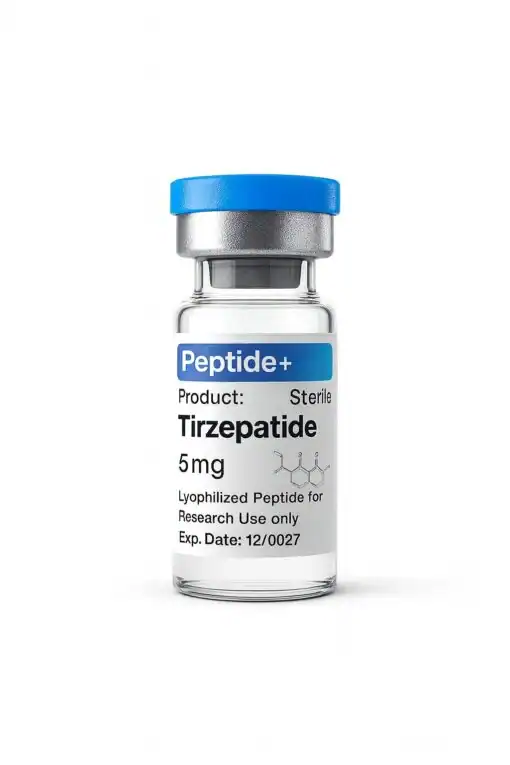
Peptides PlusTirzepatide 5 Mg
| Quantity | Discount | Price |
|---|---|---|
| 3–5 | 10% | $90,00 |
| 6–9 | 15% | $85,00 |
| 10–100 | 20% | $80,00 |
Specifications
- Brand: Peptide Plus Peptides & SARMs
- Substance: Tirzepatide
- Product Form: Powder
- Dosage: 5 Mg
How To Use
Laboratory Preparation & Research Dosing Protocols
Disclaimer: The following information is for educational and laboratory reference only. This product is strictly for in-vitro and in-vivo research and is not intended for human consumption or therapeutic use.
This vial contains 5 mg (5,000 mcg) of lyophilized Tirzepatide powder. Careful handling and precision measurement are critical for accurate data collection.
Reconstitution Guide
For standard research concentration, reconstitute the 5 mg vial with 1 ml or 2 ml of Bacteriostatic Water. (Using 2 ml provides greater measuring precision).
- Preparation: Slowly inject the water against the glass wall of the vial.
- Dissolution: Swirl gently until clear. Do not shake, as the peptide structure is sensitive to mechanical stress.
- Measurement Reference (Using 2 ml dilution):
- 2 Units (0.02 ml) = 100 mcg
- 4 Units (0.04 ml) = 200 mcg
- 10 Units (0.10 ml) = 500 mcg
⚠️ Storage Specifications
- Unmixed (Lyophilized): Store in a cool, dry place. For long-term preservation, store at -20°C.
- Mixed (Reconstituted): Must be refrigerated (2°C to 8°C). Use within 14-21 days for maximum analytical integrity.
Experience Level Usage Guide
Beginner
Baseline Metabolic Secretagogue Model
Reference dosing for initial studies investigating the modulation of basal metabolic rate and early tolerance.
- Test Subject Dosage: 100 mcg to 500 mcg per administration.
- Frequency: Administered as a single dose once weekly.
- Research Aim: Assessment of subject tolerance and appetite regulation markers.
Intermediate
Advanced Thermogenic Evaluation Model
Standard dosage for evaluating the long-term impact of dual-pathway agonism on weight loss.
- Test Subject Dosage: 250 mcg to 500 mcg per week (can be split into smaller sub-doses, e.g., 250 mcg twice a week).
- Frequency: Administered on a weekly basis, or split into two smaller administrations.
- Observation Period: 4 to 8 weeks for longitudinal data collection.
Advanced
The Metabolic Synergy Stack
Advanced protocol investigating the synergy between fat oxidation and direct tissue remodeling.
- The Stack: Tirzepatide (250 mcg weekly) + BPC-157 (250 mcg daily).
- Scientific Rationale: Investigates the combined impact of profound energy expenditure/fat loss (Tirzepatide) alongside systemic soft-tissue/cytoprotective repair (BPC-157).
- Frequency: Combined weekly and daily schedule according to study objectives.
Shipping Details
Detailed Description
What Is PeptidePlus Tirzepatide 5 mg?
PeptidePlus Tirzepatide 5 mg is a highly advanced, dual-action incretin mimetic compound. It acts as a highly synergistic combined Glucose-Dependent Insulinotropic Polypeptide (GIP) and Glucagon-Like Peptide-1 (GLP-1) receptor agonist. In the scientific community, it is extensively researched for its profound ability to engage both pathways simultaneously, resulting in superior metabolic regulation, enhanced lipid clearance, and highly stabilized glycemic balance. This 5 mg lyophilized preparation is the perfect foundational instrument for high-precision USA domestic research facilities initiating new dose-titration protocols and complex body recomposition assays.
If your research goals involve exploring advanced glycemic balance and dual-receptor lipid clearance, you can buy peptides of this analytical grade through our Fat Loss Peptides category.
Important: PeptidePlus Tirzepatide 5 mg is strictly for laboratory research and is not intended for human consumption or therapeutic use.
PeptidePlus Tirzepatide 5 mg: Technical Profile
| Scientific Parameter | Details for PeptidePlus Tirzepatide |
|---|---|
| Peptide Category | Dual GIP and GLP-1 Receptor Agonist |
| Vial Concentration | 5 mg Lyophilized Powder |
| Mechanism Focus | Insulin Sensitivity, Glycemic Regulation & Satiety Signaling |
Research Benefits of PeptidePlus Tirzepatide 5 mg
In controlled laboratory settings, it is highly valued for its balanced, dual-pathway metabolic effects. Key research benefits include:
- Dual-Receptor Synergy: Studying the compound’s combined action on GIP and GLP-1 receptors to drastically improve insulin sensitivity beyond what single-pathway agents can achieve.
- Appetite Suppression: Investigating its profound action on the central nervous system to delay gastric emptying and powerfully influence hunger control mechanisms.
- Optimized Titration: The 5 mg format allows researchers to establish safe baseline tolerances in new subjects, facilitating careful dose-escalation studies without peptide waste.
- Improved Glycemic Control: Researching the peptide’s ability to blunt sharp post-meal glucose spikes and lower fasting blood sugar in metabolic dysfunction models.
How Does PeptidePlus Tirzepatide 5 mg Work?
The mechanism of Tirzepatide relies on its structural ability to mimic both GIP and GLP-1 incretin hormones. While the GLP-1 pathway acts centrally to increase satiety and slow digestion, the addition of the GIP pathway significantly enhances glucose-dependent insulin secretion and improves how the body processes lipids. This synergistic combination prevents the severe tolerability issues sometimes seen with high-dose GLP-1 alone, while yielding superior fat-reduction data. Because Peptidesline provides vacuum-sealed, analytical-grade PeptidePlus products, researchers can reliably track these physiological shifts with high accuracy.
Potential Side Effects in Research Models
Researchers utilizing Tirzepatide must monitor for physiological responses associated with its administration:
- Gastrointestinal Distress: Nausea, vomiting, or gastric discomfort are the most commonly observed effects during initial exposure as the digestive rate slows.
- Metabolic Variation: Fluctuations in baseline glucose markers require close monitoring, though severe hypoglycemia is rare due to its glucose-dependent nature.
- Localized Sensitivity: Possible mild redness, warmth, or irritation at the subcutaneous injection site.
Tirzepatide vs. Alternative Metabolic Peptides
| Research Agent | Targeted Action | Main Research Strength |
|---|---|---|
| Semaglutide | GLP-1 Receptor Agonist | Provides highly stable baseline glycemic regulation and reliable appetite suppression via a single pathway. |
| Retatrutide | Triple GIP/GLP-1/Glucagon Agonist | Produces the highest observed level of direct liver fat oxidation and basal metabolic rate increases. |
| Tirzepatide 5 mg | Dual GIP / GLP-1 Agonist | Offers an ideal balance: superior insulin sensitivity and lipid clearance with generally better gastrointestinal tolerability than pure GLP-1s. |
Buy PeptidePlus Tirzepatide 5 mg Online
When conducting critical lipid metabolism or initial dose-titration assays, Peptidesline is your reliable source for batch-certified compounds. Our Tirzepatide is HPLC-verified for 100% integrity.
- Express USA Delivery: Fast shipping to your research facility in 4-7 business days.
- Secure Checkout: Simple payment options via Zelle or Venmo.
- 10% Crypto Discount: Unlock a 10% discount on Tirzepatide 5 mg by paying with Bitcoin or USDT.
- Click here for Payment Options
FAQ
Tirzepatide is a dual agonist, meaning it hits two different receptors (GLP-1 and GIP) at the same time. At Peptidesline.com, it is researched for providing a much more powerful metabolic boost and better blood sugar management than peptides that target only one receptor.
The 5 mg vial is the optimal format for initiating new test subjects into a Tirzepatide protocol. Because it is a highly potent dual-agonist, researchers must begin with low baseline doses (e.g., 2.5 mg weekly) to assess gastrointestinal tolerance. The 5 mg format provides exactly enough compound for the first two weeks of titration, preventing the peptide degradation and waste that would occur if researchers tried to draw micro-doses from a larger 10 mg or 15 mg vial over a month.
While GLP-1 effectively slows digestion and suppresses appetite, adding GIP creates a synergistic effect that directly enhances how the body handles lipids and insulin. GIP activation significantly improves insulin sensitivity and reduces glucagon levels more efficiently than GLP-1 alone. Furthermore, researchers frequently note that engaging the GIP receptor helps mitigate some of the severe nausea associated with pure GLP-1 agonists, resulting in better overall tolerability in models.
No, Tirzepatide has an excellent safety profile regarding severe blood sugar drops. Its mechanism of action is 'glucose-dependent,' meaning it only signals the pancreas to secrete insulin when blood glucose levels are actively elevated (such as after a meal). It does not blindly force insulin into the bloodstream, making it highly stable and safe for exploring fat-loss parameters in metabolically healthy models.
The most critical factor in managing gastric distress is adhering to a strict, slow dose-escalation schedule. Researchers typically hold the dosage steady for a minimum of 4 weeks before increasing it, allowing the subject's central nervous system and digestive tract to adapt to the delayed gastric emptying. Modifying the feeding schedule to smaller, more frequent volumes also greatly reduces instances of nausea and vomiting.
Semaglutide is a single agonist (GLP-1), while Tirzepatide is a dual agonist (GIP and GLP-1). This extra pathway often leads to more significant fat loss and improved tolerability.
Tirzepatide is a complex, fragile dual-chain molecule. It must be reconstituted gently by slowly dripping bacteriostatic water down the inner glass wall of the vial. The vial should only be gently swirled until the powder dissolves—it must never be shaken vigorously, as physical agitation will sheer the peptide bonds. Once mixed into a liquid, it requires continuous refrigeration between 2°C and 8°C and should be utilized within 21 to 30 days.